Moo: Not the end, just a new normal
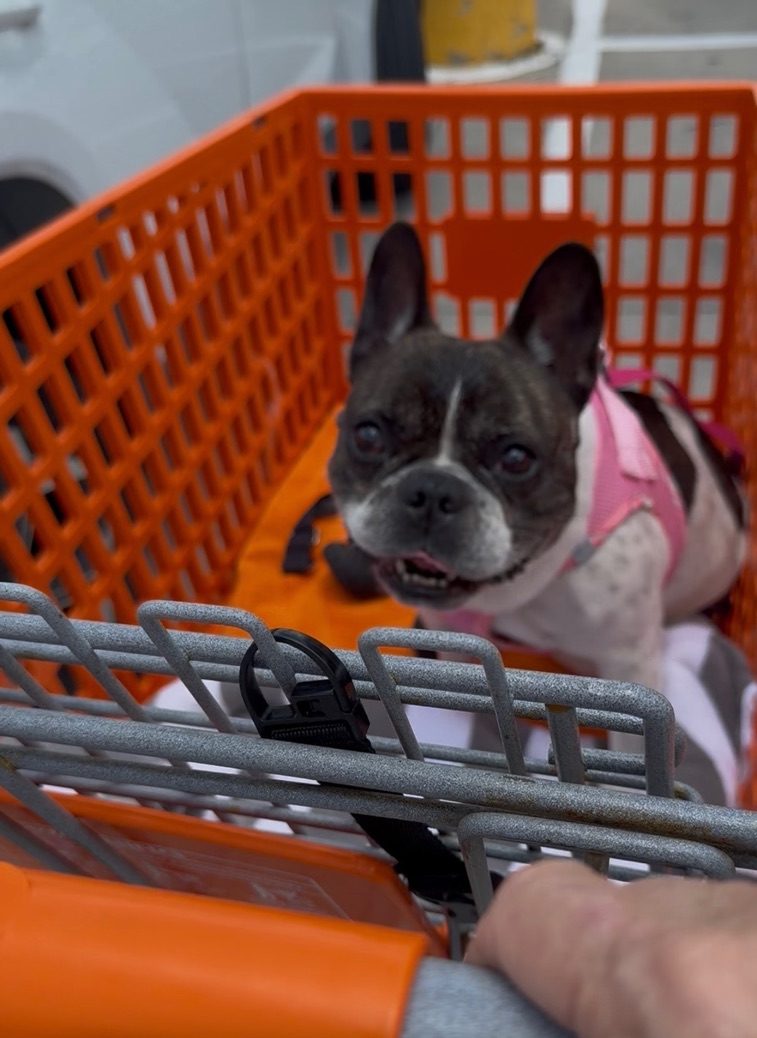
Moo was a goofy, loud, zoomie-loving French bulldog when her back gave out in rural Kenya, where no one nearby knew IVDD. Two years later she wears diapers and little shoes, rides in a stroller, and is, in Michelle's words, maybe even happier. This is their story.
The experiences, advice and opinions on this page are Michelle's, not a veterinarian's, and not Tendi's guidance. Every dog and every situation is different. Do your own research, and work with your vet and a veterinary neurologist to find the right treatment plan for your dog.
A cute little cow of a puppy
Michelle got Moo during the pandemic. As a puppy she was, as Michelle puts it, "just super goofy, as a lot of Frenchies are. Just silly and funny, and very animated."
Her name came from the way she looked. As a tiny baby, Moo was black and white, and to Michelle she looked like a little cow. She has grown into a brindle since, but the name stuck.
Life in Kenya, and the day she wouldn't walk
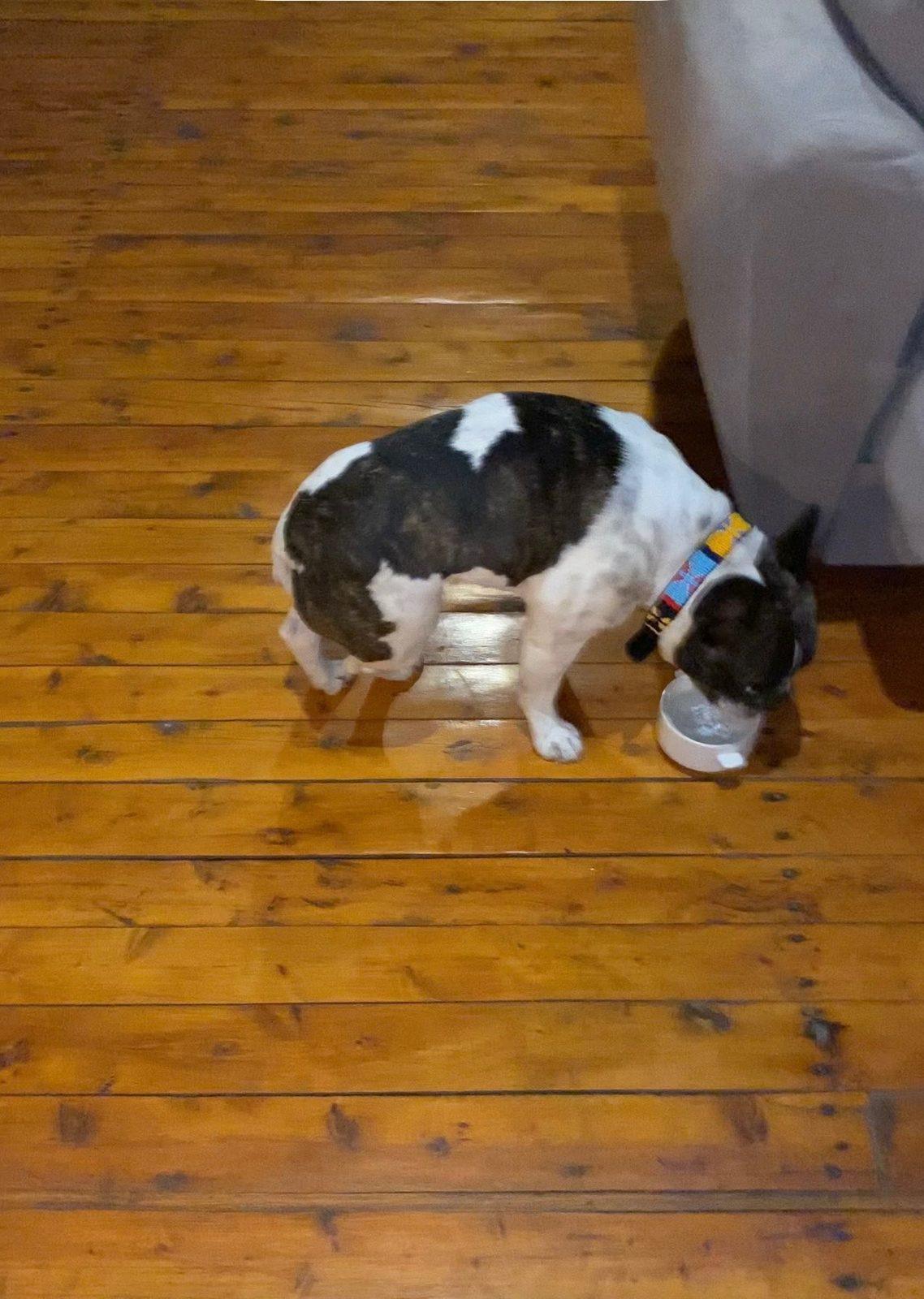
For a stretch of Moo's life, home was rural Kenya. Michelle was working with the Maasai, living in the bush, and Moo had plenty of company. "She had a lot of friends, and she would be very vocal with them, and jump around and be silly," Michelle says. "Zoomies, and all that stuff."
When Moo was a little over four, that changed in a day. Michelle sometimes left her in the cabin, "or tent, whatever you want to call it," while she went to work. One day she came back and Moo didn't want to walk.
"I thought she was just being a belligerent Frenchie, because they do that sometimes. They're like, I'm not going for a walk."
The next day, Moo couldn't walk at all. She was shaking. She yelped a little. "You could see in her face she was in pain," Michelle remembers.
Nobody knows exactly what happened. Maybe she jumped off something. "Maybe it was a degenerative thing that just finally came to a head," Michelle says. "I'll never know."
No one nearby knew IVDD
There were no vets where Michelle lived. Even in Nairobi, the nearest big city, she couldn't find a vet who understood IVDD. So she did what a lot of scared owners do: she started searching.
"I just started Googling. I'm like, what's going on?" She knew French bulldogs are prone to IVDD, and the symptoms fit. On Frenchie and IVDD forums, the protocol people suggested was eight to twelve weeks of strict rest. "I guess I'll just do that," she remembers thinking, "because I don't know what else to do."
Her only medication was gabapentin, which a courier brought out from Nairobi. Around the one-month mark, Moo no longer seemed to be in pain, and without a vet nearby encouraging her to continue, Michelle stopped the medication. She hasn't needed pain medication since.
"I was so traumatized by the whole thing. It just crushed me."
A pen made of chairs
Michelle didn't have a crate in Africa, so she built what she had: furniture and chairs pushed together to block off a small area, lined with potty pads. Moo could still take a few steps but couldn't run around. She ate in there, and Michelle would climb in and sit with her.
Moo did not like it. She did the full eight weeks anyway.
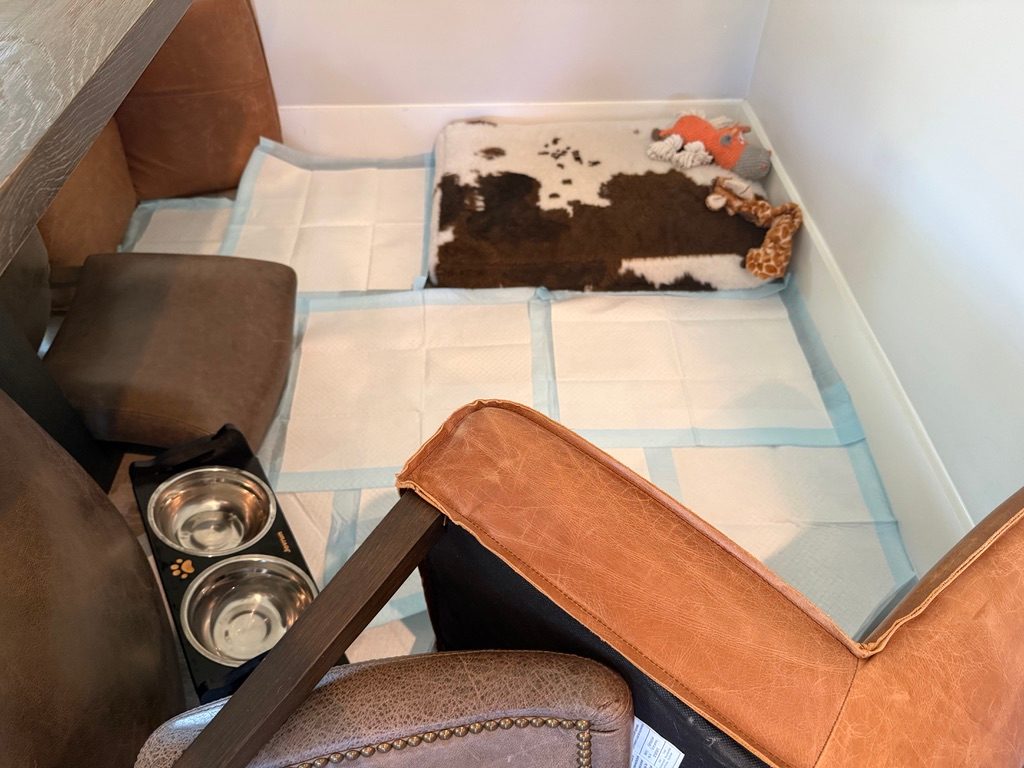
Looking back, Michelle has strong feelings about cages. She's careful to frame them as her own opinion: "These are just me shooting from the hip. I'm not a doctor." But she thinks confinement can mean keeping a dog from running around without shutting them in a cage. "I know people say it's their safe place. It's like, yeah, maybe. But it's a cage." For her, how a dog feels while it heals matters, especially being cut off from its people.
Watching her muscles fade
The longer the rest went on, the more Moo's back legs wasted away. "My dog's muscles atrophied so severely," Michelle says. "How is she ever going to get her muscles back? She can't weight train."
"Can you imagine if you were in the hospital for 12 weeks and you hardly got out of bed? That would be really bad."
She heard what other owners were doing: water therapy, acupuncture, expensive rehab. She tried acupuncture a few times. It didn't seem to make a difference, and Moo wasn't happy about it. Hydrotherapy was out, because Moo hates water: "I'm not going to do that. That's stressful." Later she tried an at-home red light therapy device for a while, a version of one her daughter uses on her horse. "I don't know if it helped or not."
She felt guilty, comparing herself to everyone else online. "People are like, oh, what a bad Frenchie mom you are, that you're not mortgaging your house to do all this PT." But her instinct kept coming back to the same thing:
"Intuitively, I felt like, just give this dog some time to heal, for Pete's sake. And then, if her body can't do it, we can re-evaluate."
Three months later, she was herself again
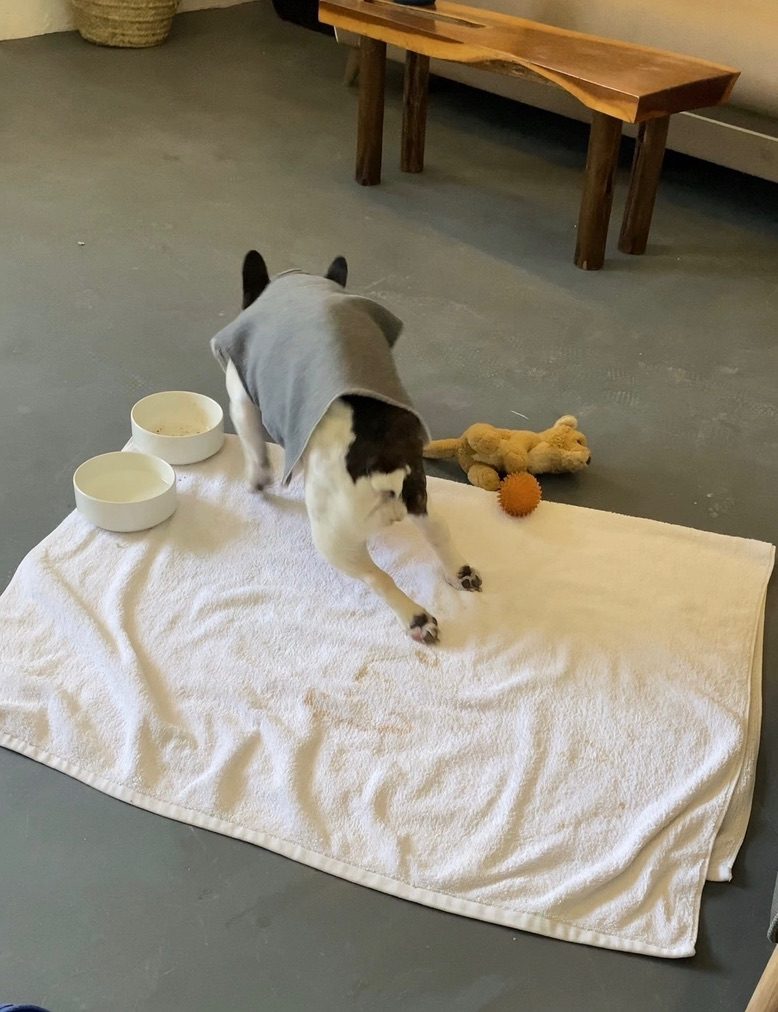
After eight weeks, Moo went back out on a leash. "I wouldn't just let her go crazy." At about three months, Michelle let her off leash, and has videos of Moo "just having the greatest time." There were no flares.
"In three months, she was just happy running around, still kind of dragging her hind end. But very happy, very animated, very much herself."
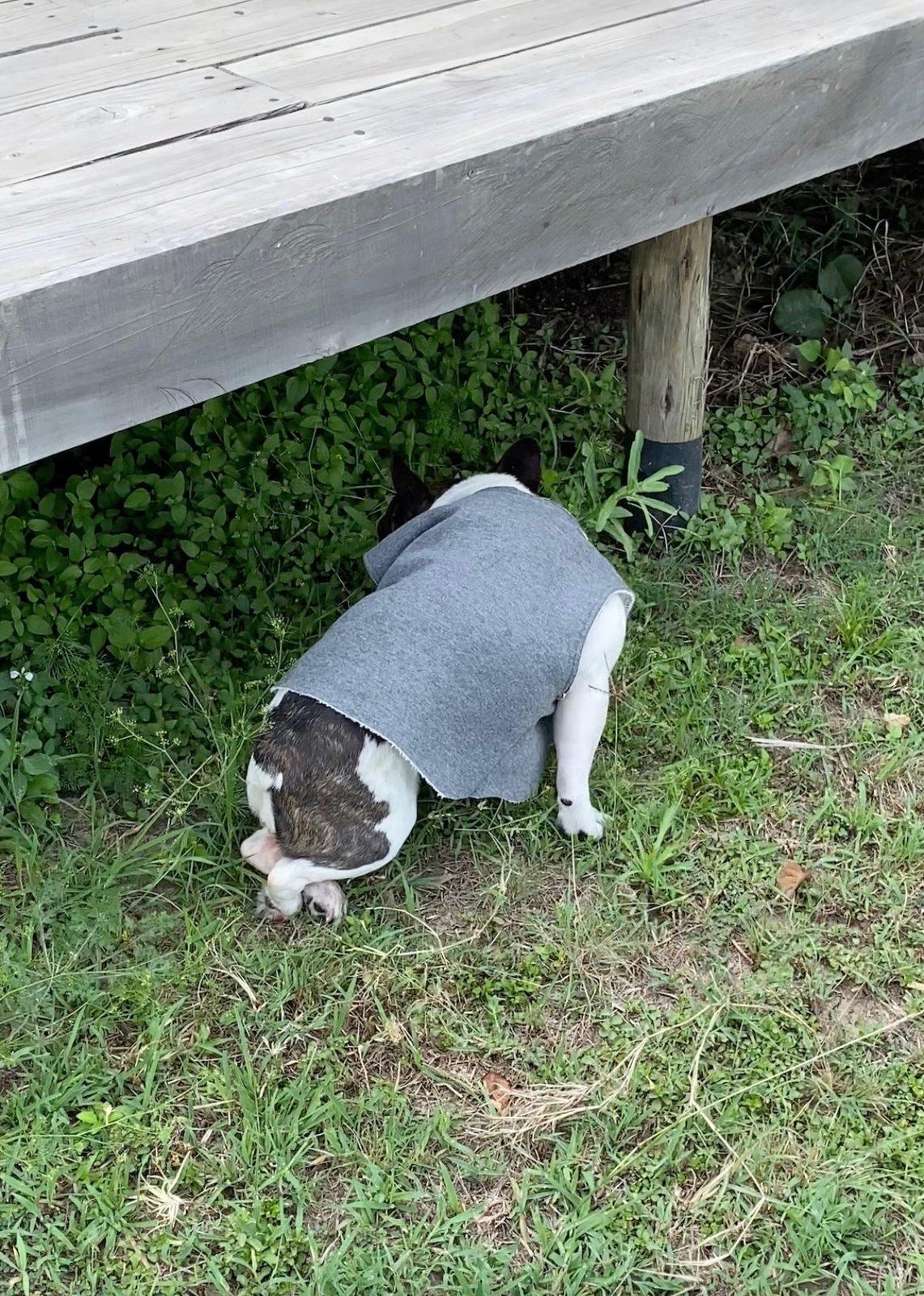
Within eight months to a year, Michelle says, she was "just fully animated," with no medication after that first month.
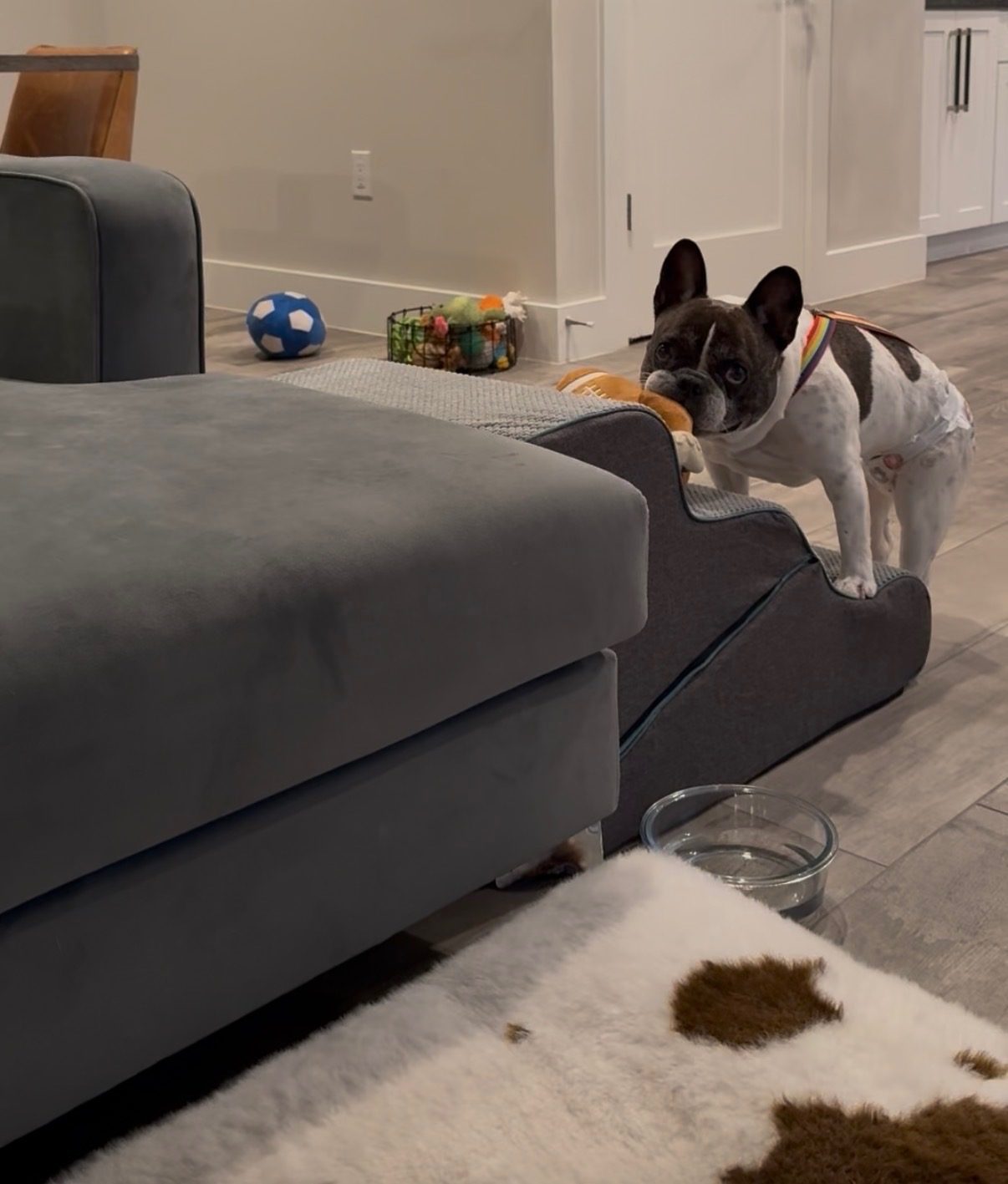
Michelle credits a lot of Moo's strength to letting her move. "I just did not bubble wrap her," she says. "She's got to be a dog." She got little pet stairs for the couch and bed, which Moo uses sometimes. And she let Moo climb the carpeted stairs at home, even though many people say never to. "She wanted to go up the stairs, and I would go behind her and let her use her muscles, and use that as PT."
Today, Michelle says, "I'm just really cautious about medications. I'd like a lot more research to be done on that." She's seen posts where dogs are on three or four medications at once and wonders why. She has also read concerns about gabapentin and found it kept Moo "a little bit dopey." That's her view from her own experience. Your vet can talk through the benefits and trade-offs for your dog.
A neurologist's honest answer
About eight months after the injury, Michelle and Moo came back to the US. In Texas she finally saw a veterinary neurologist at a neurology center that knows IVDD well.
The neurologist offered an MRI, but as Michelle remembers it, she was candid: she wouldn't put Moo under anesthesia for an MRI unless Michelle was planning surgery. And on surgery itself, "she said, the truth is, we don't know. Sometimes it fixes it, sometimes it doesn't. It's not a guarantee."
So Moo has never been formally staged. Michelle assumes it was IVDD, but she doesn't know for sure. Moo still has deep pain sensation; she's twitchy about having her feet handled. Her knuckling has improved, though it isn't gone. She isn't fully paralyzed, but she is incontinent: "she doesn't know when she's going to have to go to the bathroom. Those messages never did hook up."
Surgery was never an option for them in Kenya, and Michelle isn't sure she would have chosen it anyway. The MRI and the surgery came with high prices, she says, and she doesn't know that she would have spent that even if she had it. She had been told that if a dog doesn't get surgery "within hours of the episode, you might as well forget it," yet Moo recovered without it. She points out that surgery isn't always one and done, since some dogs still have flares afterward. And, she says, "we don't really know whether the surgery fixed it on some of these dogs, or whether the resting fixed it."
The thing that had to change was Michelle
The hardest part, Michelle says, wasn't anything Moo did. It was watching her lose the dog she used to be: "so active and playful, and jumping and running and chasing."
"I just felt so sad for her," she says. "I thought, her life is over." She was sure it was hard on both of them. And slowly she noticed that her grief and worry were rubbing off. Moo's big personality was getting "damped down."
"My attitude, I noticed, really impacted her."
What turned it around was meeting another woman and her dog, Kaiya, who was born with a disability. Kaiya wore a diaper and went everywhere in a stroller, "and no big deal, and they're just fun and silly and playful." Seeing them made Michelle look at Moo differently.
"I don't think she was sad," Michelle realized. "She's running over to the fence, she's gonna bark. She's kind of wobbly, but she still chases things." On their stroller outings, Moo was "a happy little camper." "Maybe she doesn't even realize that she lost something."
A setback, and a bounce back
Since then, there has been one scare. Michelle had to travel and boarded Moo with a woman she liked, who has other dogs. Moo played too hard. When Michelle got back, Moo couldn't walk.
"I was like, oh no, are you kidding me?" Michelle rested her, and in about a week and a half to two weeks, "she popped back out." Now she's back to normal.
Moo at six
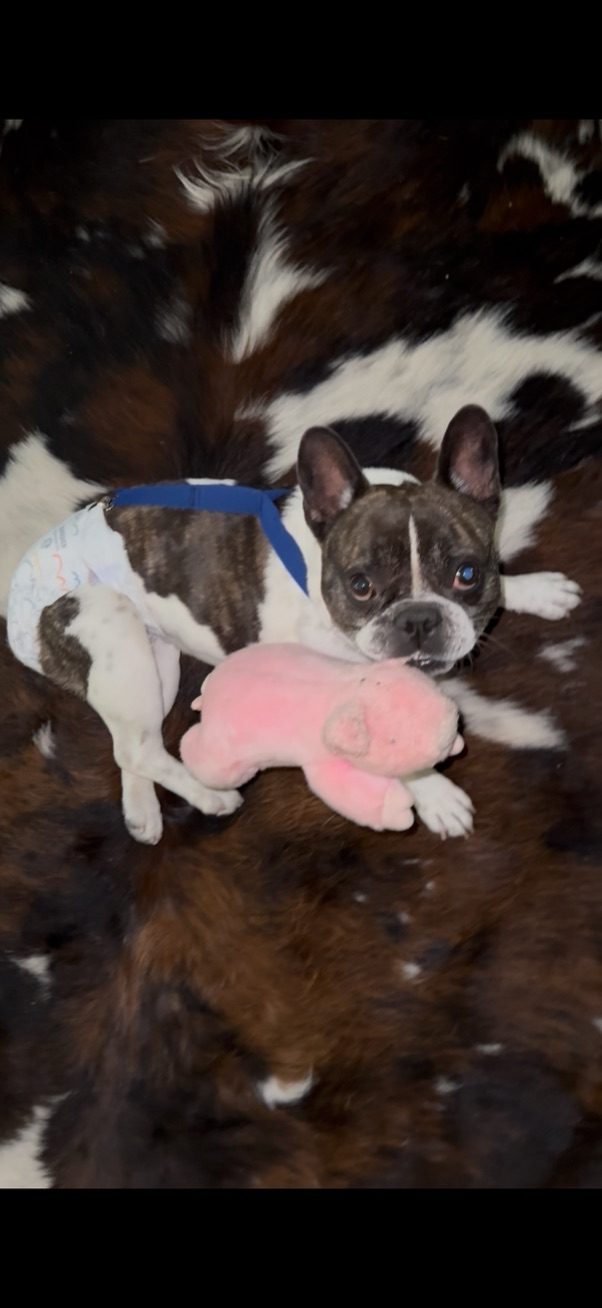
Moo is six now. She wears human diapers, held on with a little suspender rig that Michelle invented, under cute diaper covers. She wears shoes because she still drags her knuckles a little, and people tell her how cute they are. Her walk is "a little bit wonky," but once she gets going, "it looks almost normal." She has gotten most of her muscle back, which Michelle credits to letting her do things "other people would probably think is awful."
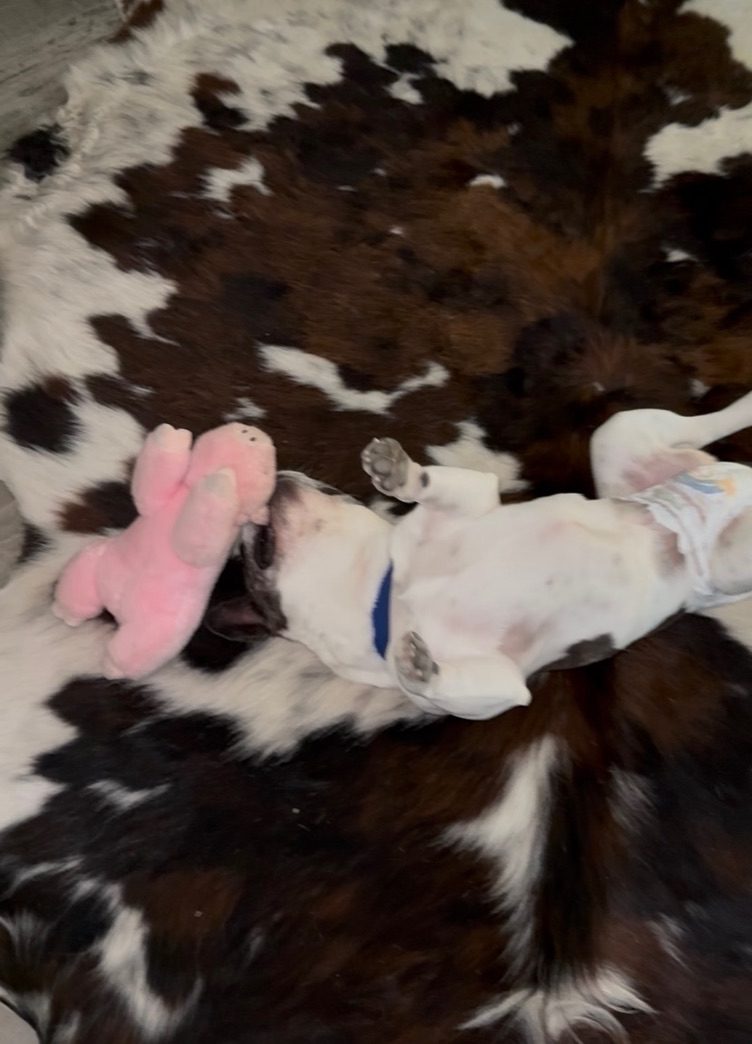
She doesn't launch herself on and off the couch the way she used to, and her zoomies aren't quite what they were. But, Michelle says, "if you didn't see the way she walks and you didn't see the diapers, you wouldn't know. She's the same dog."
"She's very happy. In fact, maybe even happier, because we do more things together now."
They travel together. "I'm like, hey, we're just gonna go everywhere together." And as soon as Michelle stopped seeing Moo's IVDD as a bad thing, she says, "it's just what it is. It's not bad. It brought us closer together, actually."
What Michelle wants other owners to hear
Michelle says telling Moo's story helped her, and there's one thing she most wants people to take from it.
Moo is proof of what Michelle wishes she'd known at the start. Setbacks happen. Recovery can look different from the "before" picture. And a dog with a wonky walk, a diaper and a stroller can still be a goofy, vocal, very happy little cow of a Frenchie, especially with someone who refuses to give up on her.
"Moo became paralyzed at age 4. This is her journey. IVDD did not diminish her life, nor steal her joy. We hope you find inspiration here."
Michelle has now started an Instagram account to inspire others with IVDD dogs, @moosjoyfullife. Give her a follow, and you can watch Moo run in the video below.
View this post on Instagram
Start with the guide that matches the hard part.
If your dog suddenly can't walk, is dragging their legs, or can't control their bladder, call a veterinarian or emergency clinic now. A story cannot replace an exam.
This story, and the advice and opinions in it, are Michelle's, from her experience with Moo. They are not a veterinarian's, and they are not Tendi's guidance. Please do your own research, and work with your vet and a veterinary neurologist to find the right treatment plan for your dog and your situation.